01COST OPTIMIZATION
Optimize cost.
Balance production, sourcing, transportation, and inventory costs across the network. Meet demand within the constraints that matter.
See the cost of each trade-off.Network planning & optimization
Built around your operation / 01
We build network-level planning on top of your existing systems.
Decide what to produce, where, and when. See which demand your plan protects, what constrains it, and how it changes when supply falls short.
 Founded by Mehdi Bennani SmiresFormer Palantir engineer
Explore the decisions
Change the conditions. See what moves,
what can be supplied, and what goes unmet.
West capacity and East materials are constrained at the same time. Only 1,900 units can be supplied against 2,400 units of demand.
| Production site | Baseline | Scenario plan | Available output |
|---|---|---|---|
| West factory | 1,000 | 600-400 | 600 |
| Central co-man | 800 | 1,000+200 | 1,000 |
| East factory | 600 | 300-300 | 300 |
200 units unmet · hatched segment
300 units unmet · hatched segment
When everything cannot be supplied
The company sets the priorities. The plan makes the service trade-off visible.
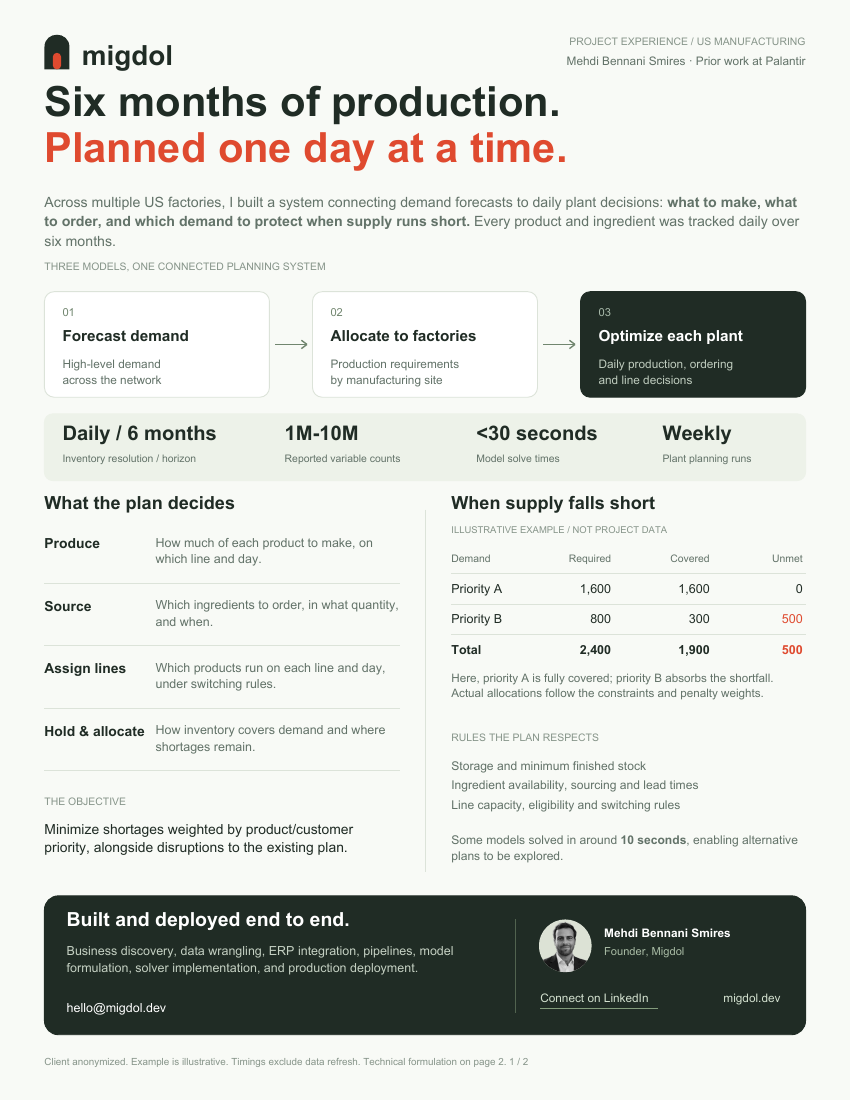
| Priority | Required | Covered | Unmet |
|---|---|---|---|
| Priority A | 1,600 | 1,600 | 0 |
| Priority B | 800 | 300 | 500 |
Cover all 1,600 units of priority A demand. Allocate the remaining 300 units to priority B, leaving 500 units unmet. This example illustrates a business-defined ranking; actual allocations depend on constraints and penalty weights.
Illustrative, precomputed plans for one product in one month. Available output reflects capacity and material limits. All quantities are units.
Project experience / Prior work at Palantir
Across multiple US factories, I connected network demand forecasts, factory allocation, and in-plant optimization. The model tracked inventory for every product and ingredient, every day, over a six-month horizon.
Weekly in-plant planning runs. Shortages were penalized by product and customer priority, alongside changes to the existing plan. Some models solved in around 10 seconds; timings refer to model solves, excluding data refresh.
 Production optimization across a US network
The model behind the plan
A production decision uses ingredients, occupies capacity, and changes tomorrow's stock. A network plan needs to account for those connections.
We translate them into mathematical optimization models, including mixed-integer linear programs, connected to your ERP and planning data.
Inside a production optimization projectFinished products and ingredients
Quantities, assignments, timing, and flows
If,i,t = If,i,t−1 + inflows − outflows
f = plant · i = item · t = dayThe formulation follows your operation. The balance above is a compact illustration of how inventory links decisions over time.
The business case
Set the objectives with your team.
Make the trade-offs visible in every plan.
Balance production, sourcing, transportation, and inventory costs across the network. Meet demand within the constraints that matter.
See the cost of each trade-off.Put constrained capacity and materials behind the demand you can fulfill. Evaluate which production and allocation decisions reduce lost sales.
Make capacity count.Test supplier delays, capacity losses, and changes in demand. Understand the exposure and compare alternatives before you commit.
Know your options before you need them.From operation to optimization
Bring together forecasts, ERP records, inventory, sourcing, and capacity. Understand how the team plans today.
Data + business contextDefine the variables, objectives, and constraints with your planners. Validate the model against actual operating conditions.
Mathematical optimizationDeploy the system into the planning cycle. Review decisions, compare scenarios, and refine it with the people who use it.
Production + continuous refinementNEW YORK / MIGDOLYour builder, from day one
At Palantir, I built and deployed production and network optimization systems with business teams. At Migdol, I bring that same involvement to your planning problem, from data integration and formulation to production deployment.
Start with a decision
Tell us about your network, your systems, and the decisions your team needs to make.
hello@migdol.dev